Thou Shalt Surely Die

The First and Second Death

In Genesis 2:16-17, God commanded Adam not to eat from the tree of the knowledge of good and evil, warning him, “in the day that thou eatest thereof thou shalt surely die.” God did not say Adam would begin dying that day. He announced death as the consequence of disobedience, and nothing in the command itself indicates that He meant a figurative or spiritual death.

A similar warning appears in 1 Kings 2:37, where Solomon told Shimei that on the day he crossed the brook Kidron, he would surely die. When Shimei violated that command, he became subject to death, although Solomon executed the sentence later, after learning of the violation. The delay did not change the meaning of the warning. Likewise, Adam sinned and became subject to death, but God did not immediately execute the sentence as Solomon did. Adam continued living and eventually died at the age of 930 (Genesis 5:5).

Genesis 3:22-24 explains why Adam eventually died. As a consequence of his disobedience, God removed him from the garden and prevented him from eating from the tree of life and living forever. Without access to that tree, Adam became subject to physical death, and also as a consequence descendants inherited that same mortal condition.

This distinction is important because physical death is not necessarily punishment for personal sin. Infants die despite having committed no personal sins. The righteous and unrighteous alike experience physical death because all are mortal. Adam’s transgression brought mortality upon mankind, but it did not make every person guilty of Adam’s sin.

Hebrews 9:27 states, “And as it is appointed unto men once to die, but after this the judgment.” This ordinary physical death is what we may call the first death. It is followed by judgment, showing that physical death itself does not settle the question of man’s accountability before God.

Romans 5:12 teaches that sin entered the world through Adam and that death passed upon all men, “for that all have sinned.” Adam introduced sin into the world, but each person becomes responsible for his own transgressions. Ezekiel 18:20 declares, “The soul that sinneth, it shall die,” while Romans 6:23 states, “For the wages of sin is death.”

Revelation 20:12-15 describes the dead standing before God and being judged according to their works. Those not found written in the book of life are cast into the lake of fire, which verse 14 identifies as the second death. Revelation 21:8 likewise connects the second death with those who remain condemned for their sins.

The difference is clear. The first death comes upon mankind because of mortality, regardless of personal guilt. The second death is the judicial punishment for sin. If ordinary physical death satisfied that judicial penalty, everyone who died would already have paid the debt. But Scripture teaches that judgment follows physical death and that those who remain condemned face the second death.

As previously stated, when Adam sinned, God did not immediately execute the death sentence He had announced. Instead, He exercised mercy and allowed Adam to continue living. That mercy extends throughout mankind’s history as God patiently deals with sinners over time until their mortal demise, rather than immediately executing the punishment their sins deserve.  The second death is not an additional judicial penalty beyond the one God originally threatened. It is the original judicial punishment, postponed through God’s mercy. It is called the second death because it follows the ordinary physical death of mortal mankind.

God did not leave mankind without hope. Romans 5:8 declares that Christ died for us while we were yet sinners. Through His sacrifice, God provided the means by which sinners could receive forgiveness and escape the judicial punishment their sins deserved.

Romans 8:1 states, “There is therefore now no condemnation to them which are in Christ Jesus.” Revelation 2:11 promises, “He that overcometh shall not be hurt of the second death.” Christians still experience physical death, but those who remain faithful to Christ have the promise of escaping the second death.

That promise also explains why Scripture warns Christians against abandoning their faith. Hebrews 10:26-29 warns against willful sin and rejecting the blood of Christ, while 2 Peter 2:20-22 describes those who escaped the corruption of the world through Christ but became entangled in it again. The second death therefore threatens both those who never come to Christ and those who turn away from Him and remain unrepentant.

Christ’s death provides the way of escape. Although mankind cannot ordinarily avoid the first death, those who come to Christ and remain faithful to Him can escape the second.

The first death comes because we are mortal. The second death comes because of sin. Through Christ, we can escape the second death.

Posted in Travis Main | Tagged , , , , , | Comments Off on Thou Shalt Surely Die

Did Jesus Come to Judge or Not?

Did Jesus Come to Judge or Not?

When reading the Gospel of John, we sometimes encounter statements that, at first glance, appear to contradict one another. One example concerns the reason Jesus came into the world. In John 9:39 Jesus said, “For judgment I am come into this world.” Yet in John 12:47 He said, “I came not to judge the world, but to save the world.” These statements seem to say exactly the opposite. Did Jesus come into the world for judgment, or did He not come to judge? Rather than ignoring the difficulty or changing the words Jesus spoke, we need to examine the context in which each statement was made.

The first statement comes at the conclusion of the account of the man who had been blind from birth. Jesus healed the man, but the Pharisees refused to accept what the miracle demonstrated. As the chapter progresses, an interesting contrast develops. The man who had been physically blind begins to see more and more clearly who Jesus is. At first he simply refers to Him as “a man that is called Jesus” (John 9:11). Later he recognizes Jesus as a prophet (John 9:17). Eventually, when Jesus reveals Himself to him, the man says, “Lord, I believe. And he worshipped him” (John 9:38).

The Pharisees move in the opposite direction. They possessed physical sight and considered themselves capable of seeing spiritual matters clearly, yet they refused to accept the evidence that was before them. This is the setting in which Jesus said, “For judgment I am come into this world, that they which see not might see; and that they which see might be made blind” (John 9:39).

Jesus explains the kind of judgment He has in mind by what He says next. Some of the Pharisees heard Him and asked, “Are we blind also?” Jesus answered, “If ye were blind, ye should have no sin: but now ye say, We see; therefore your sin remaineth” (John 9:40–41). The coming of Jesus was exposing the spiritual condition of men. The man who knew he had been blind came to see, both physically and spiritually. Those who claimed that they could see rejected the One whom the evidence identified as being from God. In this sense, the coming of Christ brought judgment. His presence, His teaching, and His works revealed what was in the hearts of men.

This same idea appears earlier in John’s Gospel. John 3:17 says, “For God sent not his Son into the world to condemn the world; but that the world through him might be saved.” Yet only two verses later we read, “And this is the condemnation, that light is come into the world, and men loved darkness rather than light” (John 3:19). Jesus came as the Light. His purpose in coming was not to condemn the world, but His coming nevertheless exposed men. Some came to the Light, while others rejected the Light because they loved darkness.

Now consider the other side of the apparent contradiction. In John 12:47 Jesus said, “And if any man hear my words, and believe not, I judge him not: for I came not to judge the world, but to save the world.” Here Jesus clearly states the purpose of His mission. He had not come into the world at that time for the purpose of executing final judgment upon mankind. He had come to provide salvation.

However, Jesus did not stop speaking at verse 47. The next verse is essential to understanding what He meant. He continued, “He that rejecteth me, and receiveth not my words, hath one that judgeth him: the word that I have spoken, the same shall judge him in the last day” (John 12:48). Therefore, when Jesus said that He had not come to judge the world, He was not teaching that judgment would never take place. He specifically pointed to a future judgment “in the last day.”

This distinction becomes even clearer when we consider other statements Jesus made in John. In John 5:22 He said, “For the Father judgeth no man, but hath committed all judgment unto the Son.” A few verses later Jesus described a coming resurrection in which those who have done good will come forth “unto the resurrection of life,” and those who have done evil “unto the resurrection of damnation” (John 5:28–29). Jesus then said, “as I hear, I judge: and my judgment is just” (John 5:30). It therefore cannot be true that Jesus never judges. The Father has specifically entrusted judgment to Him.

This also helps us understand another statement that could otherwise be confusing. In John 8:15 Jesus told the Pharisees, “Ye judge after the flesh; I judge no man.” If the statement “I judge no man” were taken to mean that Jesus never makes judgments about men, it would contradict both His actions and His other statements. In fact, the very next verse says, “And yet if I judge, my judgment is true: for I am not alone, but I and the Father that sent me” (John 8:16). Jesus did make judgments during His ministry. He identified sin, exposed hypocrisy, declared men to be wrong, and warned people concerning the consequences of unbelief. The statement “I judge no man” therefore cannot mean that Jesus never makes a judgment.

The broader teaching of John helps explain His meaning. Jesus did not come into the world on His first coming for the purpose of carrying out the final judgment of mankind. He came to save. Nevertheless, His coming had a judging effect because the Light exposed what was in men. Furthermore, Jesus could and did make righteous judgments during His earthly ministry. Ultimately, He will exercise the authority given to Him by the Father and judgment will take place on the last day.

We can therefore understand the statements without changing either one. When Jesus said, “For judgment I am come into this world” (John 9:39), the context concerns the effect His coming had upon men. His presence exposed spiritual sight and spiritual blindness. When He said, “I came not to judge the world, but to save the world” (John 12:47), the context concerns the purpose of His mission. He came to provide salvation rather than to execute the final judgment at that time. Verse 48 then points forward to the judgment that will occur “in the last day.”

The apparent contradiction disappears when each statement is allowed to remain in its context. Jesus came into the world to save, not to carry out the final judgment of mankind during His earthly ministry. Yet His coming necessarily brought judgment in another sense: the Light exposed men’s hearts and revealed whether they would believe or reject Him. Jesus also possessed the authority to make righteous judgments, and the Father has committed final judgment to Him. The passages do not contradict one another. Rather, they describe different aspects of Christ’s work and show why context is necessary for understanding what Jesus meant when He spoke of judgment.

Posted in Travis Main | Tagged , , , | Comments Off on Did Jesus Come to Judge or Not?

The Washing of Regeneration and Renewing of the Holy Spirit

The Washing of Regeneration and Renewing of the Holy Spirit

Titus 3:5 is sometimes understood to teach that the Holy Spirit directly enters a person at conversion and inwardly regenerates or renews him. But when the language of the passage is compared with the way Scripture describes washing, regeneration, renewal, and the work of the Holy Spirit in revealing God’s Word, I believe another explanation fits the biblical evidence better. I understand Paul to be describing water baptism and the renewing power of the Spirit-revealed Word of God.

“Not by works of righteousness which we have done, but according to his mercy he saved us, by the washing of regeneration, and renewing of the Holy Ghost; which he shed on us abundantly through Jesus Christ our Saviour; that being justified by his grace, we should be made heirs according to the hope of eternal life.” – Titus 3:5-7, KJV

According to His Mercy He Saved Us

Before examining the washing and renewing, we need to identify Paul’s main statement:

“…according to his mercy he saved us…” – Titus 3:5

That statement stands on its own. Paul does not say that we saved ourselves through our own righteousness, through ideas or systems designed by man. In fact, he expressly denies that: “Not by works of righteousness which we have done…” The reason for God’s saving action is His mercy. Then Paul adds a phrase explaining the means through which this salvation occurred:

“…by the washing of regeneration, and renewing of the Holy Ghost.” – Titus 3:5

The Greek preposition διά (dia) carries the idea of “through” or “by means of.” The structure, therefore, is:

According to His mercy – He saved us – through the washing of regeneration and renewing of the Holy Spirit.

This is important. Baptism and renewal are not being presented as righteous works by which man earns salvation. Paul has just excluded that idea. They belong to the means God has provided within His merciful saving work.

The Washing of Regeneration

The Greek word translated “washing” is λουτρόν (loutron), referring to a washing or bath. Paul associates this washing with regeneration—a new beginning, new life, or new condition. That language fits naturally with the New Testament teaching concerning water baptism.

“And now why tarriest thou? arise, and be baptized, and wash away thy sins, calling on the name of the Lord.” – Acts 22:16

“The like figure whereunto even baptism doth also now save us…” – 1 Peter 3:21

“Therefore we are buried with him by baptism into death: that like as Christ was raised up from the dead by the glory of the Father, even so we also should walk in newness of life.” – Romans 6:4

The expression “washing of regeneration” therefore fits naturally with water baptism – the washing associated with entering the new life in Christ. The water itself possesses no mystical power. Neither is baptism a righteous work by which man earns salvation. It is an act of the obedience of faith within the means established by the God who saves according to His mercy.

The Renewing of the Holy Spirit

“…and renewing of the Holy Ghost.” – Titus 3:5

The Greek expression is: ἀνακαινώσεως πνεύματος ἁγίου (anakainōseōs pneumatos hagiou). The word translated “renewing,” ἀνακαίνωσις (anakainōsis), occurs only twice in the New Testament.

“And be not conformed to this world: but be ye transformed by the renewing of your mind, that ye may prove what is that good, and acceptable, and perfect, will of God.” – Romans 12:2

That occurrence is extremely helpful because Paul identifies what is being renewed: the mind. The person is transformed through the renewing of his mind. This gives us reason to question an assumption that “renewing of the Holy Spirit” in Titus 3:5 describes a personal indwelling of the Holy Spirit producing an invisible, direct alteration of man’s nature. Paul’s other use of “renewing” points us toward a transformation involving the mind.

Renewal Through Truth and Knowledge

“If so be that ye have heard him, and have been taught by him, as the truth is in Jesus…” – Ephesians 4:21

“And be renewed in the spirit of your mind; And that ye put on the new man…” – Ephesians 4:23-24

Notice the progression: hearing → teaching → truth → renewed mind → new man.

Renewal is connected with truth entering and changing the mind.

“And have put on the new man, which is renewed in knowledge after the image of him that created him.” – Colossians 3:10

Taken together: Romans 12:2 – renewing of the mind. Ephesians 4:21-23 – truth is heard and taught, resulting in renewal of the mind. Colossians 3:10 – the new man is renewed in knowledge. This gives us a consistent biblical picture. Renewal involves the transformation of man’s thinking through truth and knowledge, producing a changed life.

Where Did That Truth Come From?

The truth capable of producing this renewal did not originate with man. It was revealed by the Holy Spirit.

“Howbeit when he, the Spirit of truth, is come, he will guide you into all truth…” – John 16:13

“But God hath revealed them unto us by his Spirit…” – 1 Corinthians 2:10

“Which in other ages was not made known unto the sons of men, as it is now revealed unto his holy apostles and prophets by the Spirit.” – Ephesians 3:5

This establishes an important distinction: The Holy Spirit is not the Word. But the Holy Spirit revealed the Word. The Spirit worked through inspired men to reveal God’s truth. That revealed truth could then be heard, understood, believed, obeyed, and lived. Therefore, understanding the “renewing of the Holy Spirit” as renewal accomplished through Spirit-revealed truth does not minimize the Holy Spirit’s work. It identifies the means through which His work affected the minds and lives of men.

Born Again Through the Word of God

Peter provides another important connection between truth, obedience, and regeneration:

“Seeing ye have purified your souls in obeying the truth through [a spirit of] unfeigned love of the brethren, see that ye love one another with a pure heart fervently: Being born again, not of corruptible seed, but of incorruptible, by the word of God, which liveth and abideth for ever.” – 1 Peter 1:22–23

Notice the relationship Peter establishes:

obedience → truth → purification

and

new birth → through the Word of God.

Peter does not describe the new birth as the result of a direct operation upon the human mind. He specifically identifies the living and abiding Word of God as the means through which they had been born again. This fits the pattern we have already seen. The Holy Spirit revealed the truth through the apostles and prophets. That revealed Word was then heard, believed, and obeyed by men. Thus, the relationship is not that the Holy Spirit and the Word are the same thing. Rather:

The Holy Spirit revealed the truth.

The Word communicated that truth to men.

Men obeyed that truth.

Through the living and abiding Word of God they were born again.

Peter therefore provides another important connection between regeneration and the Word of God. When this is placed alongside Paul’s statements concerning the renewing of the mind through truth and knowledge, it strengthens the understanding that the “renewing of the Holy Spirit” in Titus 3:5 can be understood as the renewing work accomplished through the truth the Holy Spirit revealed.

Washing, Water, and the Word

“That he might sanctify and cleanse it with the washing of water by the word.” – Ephesians 5:26

Compare Paul’s language:

Titus 3:5: “washing of regeneration” + “renewing of the Holy Spirit”

Ephesians 5:26: “washing of water” + “the word”

These passages should not simply be declared identical. Titus does not explicitly say “water and the Word.” Nevertheless, the comparison is significant. Paul can associate washing with water, while also associating that washing with the Word. When this is combined with the passages showing that renewal takes place through truth and knowledge, and that the Holy Spirit was responsible for revealing that truth, the pieces begin to fit together.

Water and Spirit in John 3:5

“Except a man be born of water and of the Spirit, he cannot enter into the kingdom of God.” – John 3:5

Here again we encounter two elements: water and Spirit. Titus 3:5 likewise contains two corresponding ideas: washing and Holy Spirit. I understand the water in these passages to refer to water baptism. I understand the Spirit’s part in regeneration to be accomplished through the truth He revealed. This does not mean that the word “Spirit” should simply be replaced with the word “Bible” or “Word.” They are not synonymous. Rather: The Spirit is the revealer. The Word is the revelation. The mind is renewed through that revealed truth. The renewed mind produces a changed life.

The Holy Spirit Was Poured Out

“Which he shed on us abundantly through Jesus Christ our Saviour.” – Titus 3:6

The Greek grammar points the relative pronoun back to the Holy Spirit. Paul is saying that God poured out the Holy Spirit abundantly through Jesus Christ. There is no need to explain that statement away.

“I will pour out of my Spirit upon all flesh…” – Acts 2:17

“Therefore being by the right hand of God exalted, and having received of the Father the promise of the Holy Ghost, he hath shed forth this, which ye now see and hear.” – Acts 2:33

The Holy Spirit was poured out. The Spirit worked through inspired men to reveal and confirm God’s truth. Therefore, verse 6 does not require a doctrine of a direct, nonmiraculous personal indwelling that regenerates every Christian. It explains the Holy Spirit mentioned in verse 5: this is the Spirit whom God had poured out abundantly through Jesus Christ. The Spirit’s work through inspired men produced the revealed Word by which regeneration of the minds and lives of men became possible. That understanding allows both statements to stand exactly where Scripture places them: The Spirit really was poured out. And men are renewed through the truth and knowledge that the Spirit revealed.

The Complete Picture

We can now return to Titus 3:3-7 and see Paul’s complete thought.

“For we ourselves also were sometimes foolish, disobedient, deceived, serving divers lusts and pleasures…” – Titus 3:3

Something had to change. The foolish needed knowledge. The deceived needed truth. The disobedient needed to become obedient. Those enslaved to lusts needed transformed minds and lives.

“But after that the kindness and love of God our Saviour toward man appeared…” – Titus 3:4

God acted. Why? Because of His mercy.

“Not by works of righteousness which we have done, but according to his mercy he saved us…”– Titus 3:5

How?

“…by the washing of regeneration, and renewing of the Holy Ghost.” – Titus 3:5

I understand these two expressions as describing water baptism—the washing associated with regeneration and entrance into the new life—and the Spirit-revealed Word—the truth through which the mind is renewed and the life transformed. The Holy Spirit was poured out through Jesus Christ. Through inspired men He revealed God’s truth. That truth was preached, heard, believed, and obeyed. The sinner who responds to that truth through obedience of faith is baptized into Christ and rises to walk in newness of life. The Word continues to renew his mind, knowledge, thinking, conduct, and life.

“That being justified by his grace, we should be made heirs according to the hope of eternal life.” – Titus 3:7

The complete picture is therefore beautifully balanced: God’s mercy is the reason He saved us. God’s grace is the basis of our justification. The Holy Spirit revealed the truth. The Word renews the minds and lives of men. Water baptism is the washing associated with regeneration and entrance into new life. None of this makes salvation something man earns. It begins with God. It originates in His kindness, love, mercy, and grace. But God chose to save man through means He Himself provided.

For that reason, I understand Paul’s expression – “the washing of regeneration and renewing of the Holy Ghost” as describing water baptism and the Spirit-revealed Word of God. The Spirit was poured out. Through inspired men He gave God’s revealed truth. The Spirit’s work through inspired men produced the revealed Word by which regeneration of the minds and lives of men became possible.

Thus the picture found throughout these passages remains remarkably consistent:

Water and the Word.
Washing and renewal.
Baptism and Spirit-revealed truth.
A renewed mind producing a renewed life.

And behind it all stands Paul’s central declaration: “According to his mercy he saved us.”

Posted in Travis Main | Tagged , , , | Comments Off on The Washing of Regeneration and Renewing of the Holy Spirit

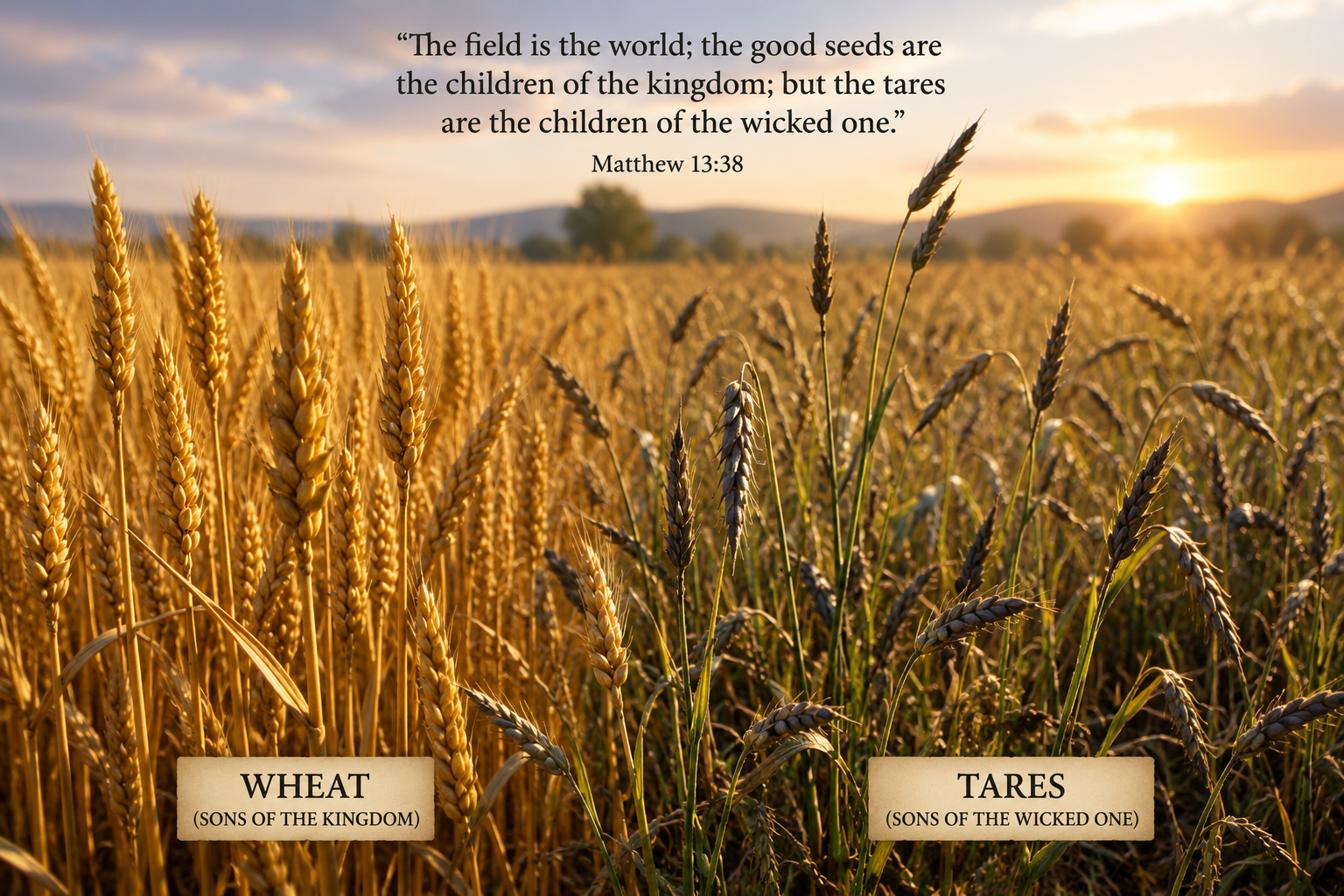
The Wheat and the Tares

The Wheat and the Tares

Why the Evidence Favors the Final Judgment

Introduction

The Parable of the Wheat and the Tares (Matthew 13:24-30; 36-43) is one of the few parables Jesus explained in detail. While nearly every figure is identified, one important question remains:

Does the harvest refer exclusively to the destruction of Jerusalem in A.D. 70, or does it describe the final judgment of mankind?

This paper does not deny the significance of A.D. 70. The destruction of Jerusalem was one of the most significant judgments recorded in Scripture and occupies an important place in the teaching of Jesus. The question is whether the Parable of the Wheat and the Tares finds its fulfillment exclusively in that event.

The thesis of this paper is straightforward:

When Matthew’s own use of judgment language is allowed to interpret the Parable of the Wheat and the Tares, the cumulative evidence strongly favors the harvest as the final judgment rather than an exclusive fulfillment in A.D. 70. While an A.D. 70 interpretation remains possible, the probability is significantly outweighed by the evidence within the Gospel itself.

Rather than beginning with disputed prophetic passages, this study first allows Matthew to define one of his own recurring expressions – “weeping and gnashing of teeth.” Once that expression is established, it becomes an important guide for interpreting the parable. This study proceeds upon a simple principle of biblical interpretation: conclusions should be drawn from the cumulative weight of Scripture rather than from isolated passages or disputed expressions.

Matthew’s First Use Establishes the Pattern

Matthew 8:11-12

Jesus declared:

“Many shall come from the east and west, and shall sit down with Abraham, Isaac, and Jacob, in the kingdom of heaven. But the children of the kingdom shall be cast out into outer darkness: there shall be weeping and gnashing of teeth.”

Matthew establishes several important truths.

  • Abraham, Isaac, and Jacob are present in the kingdom.
  • Many from every direction are gathered to them.
  • The sons of the kingdom (Faithful Israel) are excluded.
  • Those excluded experience “weeping and gnashing of teeth.”

Jesus does not explicitly identify the timing of this gathering. However, the context provides a necessary inference. Abraham, Isaac, and Jacob had long since departed this life. Therefore, the gathering described cannot be an ordinary earthly assembly.

More importantly, Scripture knows of only one gathering in which God’s redeemed are united with the faithful who have already departed this life – the consummation of God’s kingdom. Nothing in the context suggests a figurative description of Jerusalem’s destruction or any other national judgment. Matthew therefore establishes the first occurrence of “weeping and gnashing of teeth” in connection with exclusion from God’s kingdom following the gathering of His redeemed people. Unless a later context clearly requires another meaning, this becomes the natural understanding throughout the Gospel.

Matthew Consistently Uses the Expression

Matthew 13:42, 50

The expression appears twice in Jesus’ explanation of the Wheat and the Tares. The wicked are separated from the righteous, cast into the furnace of fire, and there is “weeping and gnashing of teeth.” Matthew introduces no new definition of the expression. Nothing within the immediate context suggests that “weeping and gnashing of teeth” should suddenly be understood differently from its previous use. The issue is therefore not the meaning of the expression, but the timing of the harvest.

Matthew 22:1-14

The Parable of the Wedding Feast spans several stages of redemptive history.

  • Israel rejects the invitation.
  • The king’s servants are persecuted.
  • The city is destroyed.
  • The invitation is extended to all.
  • Guests are gathered from every direction.
  • The king enters to inspect the guests.

One guest is found without a wedding garment and is cast into outer darkness where there is “weeping and gnashing of teeth.” Although the parable includes the destruction of Jerusalem, the final inspection is of an entirely different character. Scripture knows of no historical occasion in which those gathered from among the nations into God’s kingdom are individually examined by the King and cast out of His presence. Rather, the scene naturally corresponds to the final accountability of all who have accepted the King’s invitation. Matthew therefore continues using the expression exactly as it was introduced in chapter eight.

Matthew 24:45-51

The Olivet Discourse begins with Jesus’ prophecy concerning the destruction of Jerusalem. Matthew records numerous observable signs by which believers could recognize the approaching judgment. These include:

  • the abomination of desolation,
  • the flight from Judea,
  • unparalleled tribulation,
  • and the shortening of those days.

These signs enabled faithful disciples to recognize the approaching destruction and escape Jerusalem before its fall. The discourse then continues. Jesus says:

“Then if any man shall say unto you, Lo, here is Christ…” (24:23)

If verse 23 marks the continuation of the chronology beyond the description of Jerusalem’s destruction—and the sequence of Jesus’ time statements appears to indicate that it does – then verses 23-28 naturally describe an intervening period characterized by false Christs and false prophets before the appearance of the Son of Man. Jesus then declares:

“Immediately after the tribulation of those days…” (24:29)

The question naturally becomes: Which days? If the chronology has continued beyond Jerusalem’s destruction, then “those days” refer to the period just described – a period marked by deception and false teachers. Only then does Matthew record:

“Then shall appear the sign of the Son of man in heaven…” (24:30)

Unlike Jerusalem’s destruction, whose approach could be recognized through observable signs, this appearance is followed not by further signs but by repeated exhortations to readiness because the exact time remains unknown. This progression is significant. Jerusalem’s destruction was preceded by observable signs. The coming of the Son of Man is not. Rather than giving additional signs, Jesus moves toward an entirely different emphasis. He declares:

“Of that day and hour knoweth no man…” (24:36)

and

“The Son of man cometh at an hour when ye think not.” (24:44)

The Parable of the Faithful and Evil Servant conclude this section. The servant is judged, not because he failed to recognize prophetic signs, but because he was unprepared for the unexpected return of his Master. Matthew concludes:

“The lord of that servant shall come… in an hour that he is not aware of… and shall appoint him his portion with the hypocrites: there shall be weeping and gnashing of teeth.”

Whether one ultimately agrees with this understanding of Matthew 24 or not, the argument presented here rests upon the chronology of the discourse itself rather than upon an external theological system.

If the discourse has indeed progressed from the sign-filled destruction of Jerusalem to the signless coming of the Son of Man, then this occurrence of “weeping and gnashing of teeth” naturally belongs with Matthew’s other descriptions of final accountability.

Matthew 25:30

The Parable of the Talents concludes with the unprofitable servant cast into outer darkness where there is “weeping and gnashing of teeth.” Immediately afterward Matthew records the judgment of all nations (25:31-46). The literary connection is striking. Matthew’s final occurrence of the expression stands immediately before the universal judgment scene, reinforcing the understanding established in Matthew 8.

Matthew’s Literary Pattern

The expression “weeping and gnashing of teeth” becomes one of Matthew’s recurring descriptions of divine judgment. From its first occurrence in Matthew 8 through its final occurrence in Matthew 25, Matthew repeatedly employs the expression at the climax of scenes involving separation, exclusion, and accountability before God.

Passage Setting
Matthew 8 Exclusion from the kingdom
Matthew 13 Harvest and separation
Matthew 22 Exclusion from the wedding feast
Matthew 24 Judgment of the unfaithful servant
Matthew 25 Exclusion of the unprofitable servant

Regardless of how one interprets every occurrence, a clear literary pattern emerges. Matthew consistently uses the expression to conclude scenes of irreversible judgment. Those who understand Matthew 13 as referring exclusively to A.D. 70 must also explain why the same expression is repeatedly used in contexts that many interpreters – including the present writer – understand to describe final accountability before God.

The issue, therefore, is not whether an A.D. 70 interpretation is possible, but whether it best explains Matthew’s consistent use of this recurring expression throughout his Gospel.

Additional Difficulties with an Exclusive A.D. 70 Interpretation

The Angels

Jesus identifies the reapers.

“The reapers are the angels.”

Again He says,

“The Son of man shall send forth his angels.”

If the harvest is fulfilled exclusively in A.D. 70, one must explain why Matthew emphasizes the work of angels rather than the Roman armies and how their activity accomplishes the complete separation described by Jesus.

The Field

Jesus plainly states:

“The field is the world.”

The sowing takes place throughout the world. The wheat grows throughout the world. The tares grow throughout the world. The scope of the field appears considerably broader than the local judgment of Jerusalem.

The Final Separation

Jesus commands that both wheat and tares grow together until the harvest. At the harvest the separation is complete. Historically, after A.D. 70 the righteous and the wicked continued living together throughout the world. False teachers remained. Apostasy continued. The New Testament continued warning Christians concerning ungodliness within the church. The complete separation pictured by the parable appears to await a greater event.

Matthew’s Literary Pattern

Throughout the Gospel, Matthew consistently employs “weeping and gnashing of teeth” to conclude scenes of ultimate exclusion. Matthew 13 naturally fits that pattern. To assign this occurrence exclusively to A.D. 70 requires demonstrating why Matthew intentionally changes the force of one of his most recognizable expressions.

Arguments Commonly Presented for an A.D. 70 Interpretation

“The End of the Age”

Jesus says the harvest occurs at “the end of the αἰών.” Many conclude that αἰών refers to the Mosaic age and therefore identify the harvest with A.D. 70. This is certainly a possible interpretation. However, the Greek word itself does not settle the matter. Standard Greek lexicons recognize a broader lexical range including:

  • age,
  • era,
  • world-order,
  • world,
  • the material universe,
  • and even the universe itself.

Consequently, the lexical meaning of αἰών alone cannot determine the interpretation. Context – not simply dictionary definitions – must determine which meaning Jesus intended.

Old Testament Judgment Language

The Old Testament frequently describes divine judgments using imagery such as harvest, fire, clouds, and angels.

Weakness: Similar imagery does not require identical events. Jesus may employ familiar prophetic language while describing a judgment greater than any previous national judgment.

The Removal of the Wicked

Some argue that unbelieving Jews were removed in A.D. 70, thereby purifying the kingdom.

Weakness: The parable describes a complete separation of the righteous and the wicked. Following A.D. 70, however, evil continued throughout the world, false teachers remained within the church, and the righteous and wicked continued living together.

Connections with Other Prophetic Passages

Some interpret Matthew 13 through other passages they understand to describe Jerusalem’s destruction.

Weakness: Such arguments depend upon the interpretation of those passages rather than upon Matthew 13 itself. The parable should first be understood within its own context and within Matthew’s own literary pattern.

Conclusion

The question is not whether the destruction of Jerusalem was a significant biblical judgment. It unquestionably was. Nor is the question whether some of the imagery used in Matthew 13 resembles Old Testament descriptions of national judgments. It certainly does.

The real question is whether Jesus intended the Parable of the Wheat and the Tares to find its complete fulfillment in A.D. 70.

When Matthew is permitted to interpret Matthew, the cumulative evidence points in another direction.

The first occurrence of “weeping and gnashing of teeth” establishes the expression in connection with exclusion from God’s kingdom following the gathering of His redeemed people. Every subsequent occurrence outside Matthew 13 naturally reinforces that understanding. Matthew never clearly redefines the expression, nor does he indicate that its meaning changes in the Parable of the Wheat and the Tares.

Likewise, the worldwide field, the ministry of the angels, the complete separation of the righteous and the wicked, Matthew’s recurring use of “weeping and gnashing of teeth,” and the chronological progression reflected in the Olivet Discourse combine to present a picture extending well beyond the local judgment of Jerusalem.

This does not render an A.D. 70 interpretation impossible. It does, however, make it increasingly improbable.

The weight of the biblical evidence rests upon understanding the harvest as the final judgment, when the Son of Man sends forth His angels, gathers the righteous and the wicked, and forever separates them according to their eternal destiny.

The issue is therefore not what is possible, but what interpretation best explains all of Matthew’s evidence. On that question, the evidence strongly favors the final judgment.

Posted in Travis Main | Tagged , , , , | Comments Off on The Wheat and the Tares

The Promises of God

The Promises of God

Promises of God were given to the Israelites/Jews when they became a people. Both the passages surrounding Deuteronomy 28:1-6, Leviticus 26:3-5 establish that God would physically and spiritually bless the people in many ways if they walked in obedience to Him. Many of Israel’s successes and failures regarding this are recorded in the Old Testament.  Were the same promises of God that were given to Israel given to the rest of mankind in the Old Testament?  No.  However, that God provided care and blessings upon the remainder of His creation is seen not only in the Old Testament but expressed in Matthew 5:43-48 by Jesus.

In Matthew 6 it is expressed that God knows what man needs.  The passage as a whole expresses God’s providence for his creation and for the Jews, though the Jews would have the specific material promises in mind that God only gave them.  As the New Testament progresses, God reveals additional provision for all mankind through the gospel and the completed revelation of His will.  2 Timothy 3:16-17 expresses the Word’s acceptance into a man’s life allows him to be equipped for every good work which happens to be man’s purpose (Ephesians 2:10).  2 Peter 1:1-3 establishes the knowledge of that same word has been given so that man has all he needs for his walk in life and godliness.  Yet, these are just statements of provision regarding man, not promises of material goods.  Are there promises of God involving material possessions for His Christian Followers?

In answering the above question, consider that God provides by providence in many ways to His creation.  He also promised very specific things applicable to individuals, His apostles, and Christians that applied only to them and the first century (specifically the endowments through the provision of the Holy Spirit).  God’s promises to Christians are relatively few in number when compared to the extensive material and national promises given to Israel.  The New Testament focuses far more on spiritual and eternal promises than on temporal and material ones.

The Promises of God to the Christian:

  1. Forgiveness of Sins – Acts 2:38, I John 1:9
  2. Eternal Life – John 3:16, I John 2:25
  3. Resurrection – John 6:40, I Corinthians 15:52
  4. God’s Presence – Hebrews 13:5
  5. Wisdom – James 1:5
  6. A way of Escape from Temptation – I Corinthians 10:13
  7. All Spiritual Blessings in Christ – Ephesians 1:3
  8. An Inheritance – I Peter 1:4
  9. Suffering – Philippians 1:29, 2 Timothy 3:12
  10. Final Victory – Romans 8:33-39

In a nutshell, what I am trying to convey here is fairly simple. Israel received specific promises of material prosperity. Christians receive specific promises of spiritual blessing and eternal salvation. God providentially cares for all mankind. Providence should not be confused with covenant promises.

If you understand the focus of specific promises and providence to various groups, then when you read Matthew 6, you can understand why it can be true even when Christians suffer hunger and poverty.  Your understanding will also allow you to embrace how the New Testament confidently speaks of God’s care.  This will allow you to avoid the common error of treating every promise made to Israel as though it were automatically made to Christians.

Posted in Travis Main | Tagged | Comments Off on The Promises of God